

Frequent Questions
Got a question? Hang on, maybe we got an answer for you right here!

Common strategies for obtaining aviation student loans and flight training scholarships
We offer a unique and highly effective student loan application support
Academic performance-based scholarships are now available for our BSc program!
Demonstrating sufficient funding for the entire flight training program and the initial 6-12 months of living expenses abroad is a mandatory requirement when applying for a student visa at the United States, EU or Canadian consulate. If an applicant is unable to demonstrate his/her financial standing and the ability to pay for the program using personal, sponsored or loaned funds, the visa application will be rejected. Therefore, the students must have one of the following documents to prove their financial standing:
| Bank statement showing liquid funds on personal bank account, or | |
| Bank statement showing liquid funds on parent's bank account, or | |
| Bank loan sanction letter, or | |
| Scholarship awards, or | |
| Escrow account showing liquid funds provided by a sponsor |
Those students who don't have ready funding to cover their flight training tuition face the age-old question: "How can I get money for flight training?" Since 2012, AeroCadet has specialized in exactly this challenge — providing unique, enhanced student loan application support built specifically for international students pursuing an aviation career, well beyond what a typical flight school or loan advisor offers. This question is always at the top of the list for prospective pilots, whether they're training for a career, for commuting, for travel, or simply for the love of flying, and we've spent well over a decade refining the tools to answer it.
So, what are the traditional flight training financing options for the international students seeking training in the United States, Canada or the EU?
| 1 | Using personal or parent’s funds |
| 2 | Using a student loan from a local bank (most common) |
| 3 | Student loan with a co-signer |
| 4 | Using personal sponsor, such as a relative or a friend |
| 5 | Using government organization as a sponsor |
| 6 | Using business as a sponsor |
| 7 | Using flight training scholarships |
For most of these options, Aerocadet offers a special administrative support package (SLAS) that can help you obtain a student loan or a sponsorship sanction letter. Please review this process thoroughly by reading the information below in order to understand how to qualify for the aforementioned financing options. For option 7, Aerocadet awards annual flight training scholarships for international students.
AeroCadet offers a proprietary student loan application petition package especially designed to address your bank's requirements. The following points will be included in the package:
Securing international flight training requires a clear financial strategy. Contrary to common misconceptions, major training destinations—including the US, Canada, and the European Union—do not offer fully funded training grants to international students. Over 14 years of industry experience have shown us that successful candidates secure their financing through home-country sources: private financial institutions, national government initiatives, or domestic airline cadet sponsorships. Winning these funds requires more than passion; it demands proof of potential. In a competitive selection pool, sponsors look for low-risk, high-return candidates. To build a winning funding proposal, you must demonstrate pre-assessed capability, including: Certified results from recognized pilot aptitude and cognitive evaluations. Documented evaluations from industry panel interviews led by active commercial pilots. Verified professional recommendations vouching for your work ethic, safety mindset, and technical potential. Presenting a fully documented profile transforms your funding request from an aspiration into a sound investment.
AeroCadet's S.L.A.S. (Student Loan & Award Sponsorship) package is the only proprietary, aviation-specific funding petition dossier of its kind. Built from the ground up to satisfy the stringent requirements of lending committees, corporate scholarship boards, airline cadet selection panels, and government education funds, S.L.A.S. provides the exact documentation funding bodies need before committing $50,000+ toward professional flight training.
Rather than submitting a basic acceptance letter, S.L.A.S. systematically answers the core criteria evaluated by commercial banks, airline sponsors, charitable trusts, and corporate benefactors alike:
Program & Candidate Legitimacy: Verifiable accreditation and institutional credibility.
Aptitude & Risk Mitigation: Documented proof that the candidate possesses the cognitive and psychological capacity to complete high-consequence flight training on schedule.
Return on Investment & Financial Feasibility: Concrete proof of career viability, employability, and guaranteed earning potential to ensure loan repayment or fulfill corporate sponsorship objectives.
The S.L.A.S. package bundles a formal, QR-verified program acceptance letter, an exhaustive flight training and structured internship curriculum detailing fund allocation, and independent, third-party pilot aptitude assessment results certifying candidate readiness. Every document is issued on official credentialed letterhead, complete with digital verification, authorized signatures, and institutional seals.
Crucially, S.L.A.S. features a Conditional Employment Offer from Global Air (BVI) Inc., AeroCadet's international ferry and charter operation. By providing a verified, named commercial aviation employer pledging intent to contract the graduate, the dossier eliminates the primary objection faced by underwriting banks, private financiers, and airline/corporate sponsors: verified proof of future career placement and sustained repayment capacity.
Recognized across a diverse spectrum of funding entities—from international retail and private banks to regional development funds, corporate education sponsors, and civil aviation scholarship trusts—S.L.A.S. delivers a proven framework for securing capital without requiring a U.S., EU, or Canadian co-signer. Whether petitioning a domestic bank loan department, an airline cadet sponsorship committee, or a corporate philanthropy board, S.L.A.S. transforms informal requests into fully de-risked, institutional-grade funding approvals.
| Please note: since over 85% of our students come from India, Aerocadet has established itself as a trusted flight training loan petitioner to several Indian banks utilizing our SLAS package. Find out how you can apply for a Student Loan in India >>> |
Your bank or other financing organization can be furnished SLAS petition package either in self-printed format with the QR-code link to electronically-based confirmation of your acceptance status via aerocadet.com server, or it can be furnished in a full professionally-printed SLAS electronic and paper format (recommended).
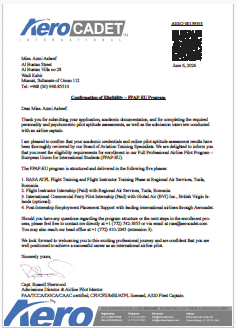 |
Aerocadet official program acceptance letter. All Banks require an official program acceptance letter confirming the applicant has passed a rigorous selection process — certificate review, aptitude testing, and interview — with acceptance formally confirmed by an experienced aviation professional. This gives the lender independent, professional expert validation of the applicant's suitability for training and aviation career. |
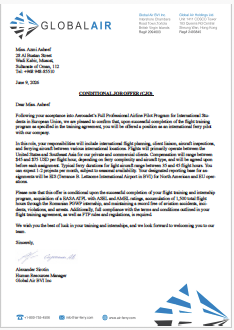 |
Conditional job offer (CJO). Upon application, banks require a guaranteed paid internship or employment offer following graduation, since this is the clearest indicator that the applicant will have the income needed to repay the loan. Without such document a lender has no assurance that tuition financing will translate into a job. Our CJO is issued by Global Air (BVI) Inc - our Caribbean-based advanced pilot internship provider. |
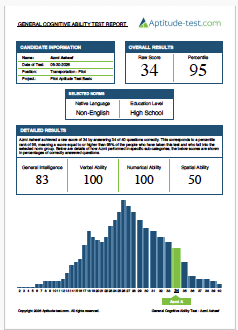 |
Pilot aptitude certification. Banks want proof that the loan applicant will actually succeed in flight training and complete it on time, within budget, and within the stipulated flight hours. That's why certified pilot aptitude scores are such a key part of the loan petition: they give the bank objective, third-party evidence of the applicant's readiness, rather than asking the loan officer to take it on faith. Our score documents come with full certification. |
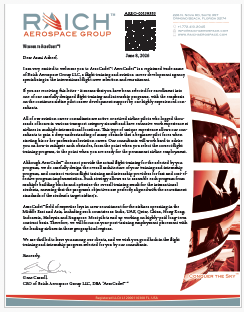 |
Legal flight training and internship agreement. All banks also require a full, legally enforceable flight training agreement — one that clearly outlines the training program, internship guarantees, and pathways to further employment placement. Without this level of detail, a loan officer has no way to confirm exactly what the funds are paying for or how the applicant is expected to reach a repayment-capable income. |
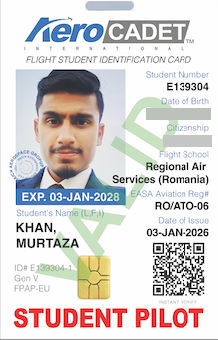 |
Electronic status verification student ID. Banks want the ability to instantly verify that the applicant is a genuine, current AeroCadet candidate. That's why every AeroCadet letter in the package includes a QR code linking to a live electronic student ID showing real-time VALID status — giving the lender an easy way to confirm on the spot that the documents are authentic, current, and not fabricated or outdated. |
For applicants who want to make an extra-professional impression during an in-person loan interview at the bank, or whose bank specifically requires original paper documents rather than electronic copies, AeroCadet offers the option to have the full S.L.A.S. package shipped via FedEx. This upgrade includes all documents professionally printed on official letterhead with authentic seals and signatures, along with the following additional items:
| Plastic student pilot ID card. Once issued, your Student Pilot ID contains a magnetic strip and embedded microchip, which can be encoded by your training airport and contracted FTP (Flight Training Provider) to grant access to secure academy facilities and designated airport areas — functioning much like a standard access-control badge used by staff and crew at any operational airfield. | |
| Custom AeroCadet pro-pilot student pilot lanyard. This is a woven lanyard designed to carry your plastic student ID, issued as above. | |
| Professional pilot program presentation folder. This is a special high-gloss presentation folder professionally designed to impress any bank loan officer, and containing all the aforementioned documents to support your student loan application process. |
 |
View sample |
The entire paper support package will be executed on our (and our third-party provider's) headed paper, with the official seals and signatures of the issuing organizations.
You, as a candidate, must understand that the choice of loan provider, as well as the actual loan application or sponsorship solicitation strategy will be entirely up to you. However, we do recommend approaching local banks with the full SLAS packet confirming your eligibility for enrollment and post-graduation conditional guarantees of well-paid employment. Normally, banks require a proof that they are lending to a legible and academically capable student who would not have any issues paying back the loan after graduation. This is why our S.L.A.S. pack is so important: it settles the bank's doubts and concerns, and it confirms your eligibility for the program.
International students applying for a domestic loan in their country must be able to demonstrate to Aerocadet a high level of English command, hold a certificate of secondary education (or higher), good fair academic matriculation scores (or higher), and take the online assessment test.
If you are from India, please review a comprehensive list of financial organisations that are known to provide student loans to the Indian applicants. We currently have dozens of active student who have successfully obtained student loans from the local banks in India using Aerocadet's SLAS package.
In order to assess your suitability and secure your employment placement upon completion of our flight training and internship program, we must ensure the validity and equivalence of your academic documents to the U.S. standard of full secondary education. This involves engaging an external agency to translate, evaluate, and verify your documents, as well as arranging for your pilot aptitude assessment test. Additionally, we will utilize a premier courier service, specifically FedEx, to deliver the required support package to you.
To offset the administrative costs associated with these essential services, we request an initial SLAS fee of $595 USD for the e-format package. If you require both electronic and paper format packages, an additional fee of $150.00 will apply. This deposit can be conveniently paid using a credit/debit card, PayPal account, or, upon request, via direct bank transfer. The fee will be collected during the second stage of your qualification process, as outlined below.
| Step 1 | SLAS Application Form: You will need to fill out a SLAS. application form and make a payment. The form is located here: Student Loan Support Application Form |
|
| Step 2 | Admission Assessment Form: once you completed the SLAS application, you will need to fill out a full admission application and assessment form and upload your documents (at least your passport and a certificate of secondary education are required to complete the application). In the "Proof of Funding" section of the form upload a previously emailed to you by us SLAS application number as a PDF file instead of uploading a bank statement. |
|
| Step 3 | Pilot Aptitude Assessment. An email from Seliant.com containing a personalized link to a short aptitude test will be sent to you within 24 hours after both forms are completed.
|
|
| Step 4 | Verification of Academic Credentials. Once we receive the test results, if deemed necessary, we may elect to send out your academic diplomas for additional verification and evaluation. In this case, it normally takes 2 additional weeks to process the paperwork using an internal evaluator or an external evaluation agency. |
|
| Step 5 | Zoom Video Interview. You will need to conduct a short (15-20 minute) admission interview over Zoom. You will need to use our online scheduling software to schedule the interview. Use this link to schedule your interview >>> |
|
| Step 5 | Signing of Program Contract. Once the positive validation feedback is received, we will send you a conditional flight training and internship contract, offer of paid internship and a letter of recommendation for flight training loan/sponsorship (the full SLAS packet). |
|
| Step 6 | Issuance of SLAS Package. The package will be issued to you via email. If you added printed documents, your documents will also be mailed in a paper format via FedEx Priority Courrier service. It normally take 3-7 working days for delivery. |
You can then use the SLAS packet to solicit for a student loan. Once you secured the required funds, you can send us the confirmation letter from your sponsor or financial institution and we will continue with the visa support paperwork, so you can obtain F-1 academic visa to the United States or Canadian Student Permit. We will then place you in the next available class for one of the FPAP programs and reserve post-graduation internship slots.
Aerocadet retains the right to decline the provision of SLAS package documents if the Applicant fails to meet the required standards of the professional pilot training program. This may occur due to unusually low pilot aptitude test scores and/or a failure to demonstrate proficiency in English during the video interview, and/or displaying an intent to exploit the Aerocadet program for illegal immigration purposes. In the event of a below-average test score, the Applicant is entitled to one free pilot aptitude re-test. Once the Applicant's information and fee have been received and the application approved, the fee is non-refundable. If the Company chooses to reject the Applicant's application for the SLAS package, the SLAS fee paid by the Applicant will be reimbursed. However, if the Applicant decides to cancel the SLAS application after paying the fees, no refunds will be issued.
Academic performance-based scholarships are now available for our BSc program!
It's important to clarify that the concept of a "flight training scholarship" or "aviation scholarship" is frequently misconstrued. In reality, an "aviation scholarship" offered to applicants at airline cadet programs often resemble a traditional student loan arrangement. Typically, a bank provides the financial support to a student based on a petition from an employer, commonly an airline or an aviation charter company. This petition includes a guarantee from the employer to offer the student a pilot position upon training completion, thereby ensuring the student's capacity to repay the loan.
|
Apply for Aerocadet ScholarshipAerocadet has a scholarship fund which annually gives out $15,000 award to three top international applicants.
Apply for Bank Loan PetitionAerocadet is the only company that provides a special bank loan petition package for international students. |
Other than the aforementioned system, there are no equivalent full flight training scholarships available for flight training candidates across North America, Europe, or other developed countries/regions. Partial flight training scholarships ($500-$5000, in total) in North America are awarded annually to high-performing domestic students with excellent grades and significant community and volunteer work involvement by several charitable organizations.
Read our blog article "How To Finance Your Aviation Training?" for more information >>
Academic scholarships are typically granted by large colleges and universities to around ten percent of their top-performing students, incurring minimal costs for the institutions. For instance, if a school hosts a lecture with a hundred paying students, they can accommodate another ten students (10%) at negligible additional expense.
However, flight training is highly personalized, involving extensive one-on-one flight instruction and the use of costly training equipment like flight simulators, FTDs, airplanes, and fuel. Flight instruction cannot be conducted in a lecture hall, and flight lessons must adhere to legal requirements, often needing customization for each student's needs. Consequently, aviation schools, colleges, and even universities, with few exceptions, cannot afford to offer free flight training programs to local or international students.
Exceptions include countries like the UAE, where the government funds flight training for selected UAE citizens; Germany, where Lufthansa sponsors training for highly competitive German nationals; Russia, where the government covers training for select Russian citizens; and China, where the government funds training for several hundred competitive Chinese nationals. Typically termed "Cadet Programs," these scholarships mandate graduates to be nationals of the sponsoring country and commit to long-term employment contracts with national airlines. For example, Chinese graduates must commit to a 60-year service period. Additionally, the Russian government won't convert Russian licenses to other ICAO formats if pilots received scholarships for their initial training.
North America (U.S. and Canada) does not have comprehensive, full flight training scholarship programs. Only partial scholarships may be awarded by certain organizations, normally to outstanding domestic students, and rarely to international applicants.
Possibly. Here is the list of all the know to us organizations that offer partial flight training scholarships to domestic and international students. Partial scholarships are limited and range in size from $500 to $5,000 USD. It's important to emphasize that domestic students are given priority over international students in scholarship awards. Due to the limitations in scholarship size and the requirement for international students to demonstrate full funding for their program to apply for a U.S. or Canadian student visa, these partial scholarship options are not considered viable for international applicants.
For those who have relatives or close friends living in the United States or Canada or Europe
Prospective students may secure financing for their training if they have a sponsor residing legally in the United States or Canada or European Union. A US/EU/Canadian sponsor must be a permanent resident with stable employment, income, or substantial savings. Such sponsors, if they don't have personal funds for student's financing, may apply for a secured (second mortgage) or unsecured loan (with a good credit rating) alongside the student at their local bank, covering up to 100% of tuition fees. In this scenario, a student typically acts as the primary loan beneficiary, while the sponsor serves as a primary co-signer. This setup ensures that if the secondary co-signer and/or beneficiary fails to repay the loan, the responsibility falls on the primary co-signer, who is a local resident. Once the loan is approved, designated for "Education," "Training," or "Career Development," the student can present the loan sanction letter as evidence of financial standing when applying for a student visa in the US, EU or Canada. The inclusion of the student's name on the loan documents is not necessary, but may help in the visa application process, as it serves as a proof that the funds are intended for the student's tuition.
Another financing option is a personal loan or gift directly given to the student by the sponsor. In this case, the sponsor must officially earmark the funds for education by opening an escrow account, naming the student as the account's official beneficiary, depositing the money, and designating it solely for educational purposes. This ensures that the escrow company disburses the funds only to educational institutions, such as colleges and flight schools. When applying for a visa, the student must present the escrow account statement and its disbursement agreement to the US consulate. An escrow account can be opened with any bank in the US or Canada.
It's essential to note that merely providing a letter from the sponsor pledging to pay for flight training is insufficient, as its validity is not verifiable. The consulate will not seriously consider such a letter. Only depositing the full amount for training into an escrow account, where the student is named as a beneficiary, guarantees that the sponsor has pledged the funds for student's training and the student will use them for training as promised, and not for any other purpose. In addition, the sponsor may issue a separate letter stating their intention to cover the student's living expenses. This letter must be accompanied by the sponsor's annual earnings statement (W-2 form in the U.S. or T-4 Slip in Canada) or EU equivalent, and/or a bank statement showing sufficient funds to cover the student's expenses.
Students can utilize our SLAS petition support package (details provided in the section below) to seek aviation scholarship sponsorship from the local airline cadet programs, local philanthropists, businesses, or government organizations.
However, as stated in the previous section, if your sponsor is either a private individual (such as a relative) or a business (or government) organization, a mere letter of sponsorship submitted with the visa application will not suffice. Such individuals or organizations must transfer the necessary funds to a specially designated scholarship escrow account. This account, which can be opened by a domestic or North American escrow company, must explicitly state that the funds are earmarked for your tuition abroad and can only be reclaimed by the sponsor in the event that you are unable to obtain a student visa. This requirement extends beyond providing proof of funding to the consulate; it necessitates presenting the terms and conditions of the escrow account charter.
Private sponsors or organizations cannot solely rely on financial statements or lists of assets as proof of funding. The U.S. or Canadian government can only consider liquid assets, such as savings and checking accounts, to ensure that an immediate access to funds will be available to the student. Investments with fluctuating values or property deeds are never accepted as valid proof of financial standing. The U.S. or Canadian consulates seek confirmation that the students will have immediate access to funds to cover projected educational costs and ensure continued financial support throughout the duration of his flight program.
Got a question? Hang on, maybe we got an answer for you right here!
Please note that we do not sponsor applicants and we do not provide academic scholarships. However, applicants can obtain student loans to cover up to 100% of tuition fees if (and ONLY if) they have a guarantor (co-signer) based in the United States. Such guarantor may be a close relative, friend, etc, and must be a permanent US resident or a US citizen.
Finding a co-signer is a highly personal and private matter, which is normally provided by your close relatives or long-term friends. You are, effectively, asking them to repay your loan of $70,000 in case you decide not, or unable to pay. So, none of our staff, our management, or myself personally, can help you with this arrangement.
The package will include the following documents: a letter confirming the suitability of your candidacy for flight training at our Full Professional Airline Pilot Program, a special flight training suitability card (issued to you after taking the Online assessment), validate your enrollment status, provide an offer of paid internship and a conditional guarantee of subsequent employment placement with the airlines. Our support pack will also include such bonus items as Aerocadet pilot lanyard.
GPA stands for Grade Point Average. It is a standard way of measuring academic achievement in the U.S. Basically, it goes as follows: Each course is given a certain number of "units" or "credits", depending on the content of the course. In secondary school, most courses carry the same number of units, but this is not true at the college level. Most college courses have a load of three units (approximately three hours of lecture and six hours of homework per week for each semester), but the number can vary from fractions of 1 to more than 5. GPA assumes a grading scale of A, B, C, D, F. Each grade is assigned a number of grade points. An A grade receives 4 points, a B=3, a C=2, a D=1, and an F=0. The process is the same whether you are working on secondary or college grades.
The biggest roadblock aspiring international pilots face isn’t skill—it’s misinformation about funding. In over a decade and a half of operation, we can tell you plainly: there is no open-ended "full financial aid" waiting for foreign students in the US, EU, or Canada, etc.
If you want to fund your training, your target must be local lenders, regional airlines, and government sponsors in your home country. But keep in mind: giving personal promises that you will work hard carries zero weight with a committee holding a limited budget.
Sponsors invest in the proven and reputable data, not personal promises. They need to see that you have already passed a rigorous pre-screening process: top-tier scores on formal pilot aptitude assessments, documented endorsements from veteran airline pilots and certified flight instructors, an interview portfolio proving you have the temperament and cognitive ability to finish training on time and on budget.
Give sponsors a reason to believe in your future by showing them verified proof of your capability today! This is exactly what our SLAS package offers.
You can review the full Frequently Asked Questions section here >>>